

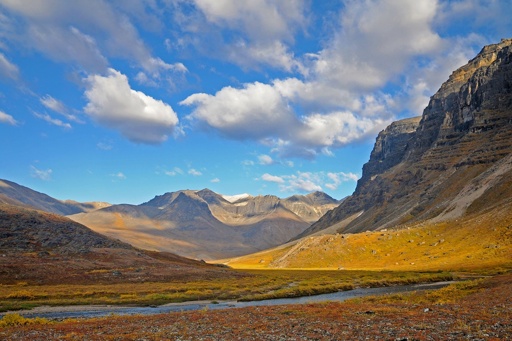


Gates of the Arctic National Park. Photo: Zach Richter, National Park Service.
Radical? Not me. In a House Natural Resources Committee hearing earlier this year, after one lawmaker finished complaining about “radical environmentalists” a second lawmaker bemusedly opined that no one is just an “environmentalist” anymore; nowadays all environmentalists are radical environmentalists.
Congressional members throwing “radical” around are definitely projecting. To “project” is to unconsciously attribute thoughts and motivations to another instead of acknowledging them as one’s own—often when it might be difficult to accept one’s own qualities, like hypocrisy, duplicity, or greed.
There have always been humans, like me, who appreciate nature-for-nature and not nature-for profit. The far-reaching, extreme action I see—the radical actors, if you will—are the lawmakers wielding the Congressional Review Act (CRA) so a greedy minority can plunder our public lands and leave us to deal with the consequences.
The CRA allows Congress to revoke a new agency regulation (aka a “rule”) with a joint resolution. Once Congress has revoked that regulation and the president has signed the resolution into law, the agency is prohibited from passing a substantially similar regulation to the one just revoked. Only future legislation can override this action.
Congress enacted the Congressional Review Act (CRA) as a negotiated rider to a 1996 budget bill. Senators Harry Reid (D-NV), Don Nickles (R-OK), and Ted Stevens (R-AK) noted in the Congressional record that they were motivated by “complaints” that Congress was passing progressively complex statutory schemes and delegating federal agencies too wide a latitude in enacting those statutes. Helpfully, they provided not even a single example of their concern manifest.
Since the CRA’s inception, however, we’ve only seen Congress wield it as a partisan sword. This is partly because the CRA requires introducing resolutions to revoke agency rules within 60 legislative or session days after agencies notify Congress about the rule, and there has to be the political clout to pass the resolution—including enough votes to override a veto if one political party doesn’t control Congress and the White House. This tends to happen within the first few months of new Congresses where political power has shifted and a new administration that wasn’t in charge when the agency created the rule.
Sword in hand, Congress cut down its first regulation in 2001, only months into the first George W. Bush administration. Voting largely along party lines, Republicans used the CRA to revoke a Clinton-era regulation designed to minimize on-the-job ergonomic risk factors and reduce preventable injuries. The Occupational Safety and Health Administration had studied the topic for 10 years before issuing a regulation—the House voted to extinguish the regulation after just an hour of debate.
The CRA next struck in 2017-2018, when the Republicans once again had unified control of the government. During the first Trump administration, Congress negated sixteen Obama-era regulations with the CRA, including U.S. Fish and Wildlife Service regulations that banned bear baiting and killing bears and wolves in their dens in national wildlife refuges in Alaska. And when the Democrats swept in with unified control in 2021-2022, they struck down three regulations from the previous administration.
The CRA doesn’t attempt to improve agency action—it is designed to destroy regulations with one final dagger through the heart. Congress can’t tweak a rule—it’s an up-or-down vote.
This year, with power once again unified under one party, Congress applied the CRA to kill three public-land management plans. Notably, Congress has not before this year considered land-management plans as rules or regulations. Applying the CRA to these is a novel application of the law, and also a novel interpretation of a “rule.”
Agencies manage our federal public lands with land-management plans. Agency employees spend years developing the plans and taking public comment on them. Longstanding statutes like the Federal Land and Policy Management Act (FLPMA) and the National Forest Management Act (NFMA), both passed in 1976, guide these plans with authorizations and restrictions. They mandate the agencies to manage land for multiple uses with more robust Congressional direction than the CRA’s “Well, we don’t like this” style. Unsurprisingly, land-management plans have many components to achieve multiple goals, permitting activities in certain places while prohibiting them elsewhere. Courts may review these plans to decide whether they comply with environmental laws or whether agencies exceeded their authority under FLPMA or NFMA. While the process certainly isn’t perfect, planning for millions of acres of public land across multiple ecosystems is now at the whim of lawmakers who dislike as little as one plan component.
One of the CRA joint resolutions that Congress has passed and is waiting for the President’s signature nullifies the Central Yukon land-management plan in Alaska, which would have governed over thirteen million acres of land in central and northern Alaska. Three million of those acres were designated as an area of critical environmental concern and overlapped with the Ambler Mining Road proposal, prohibiting it. The Ambler Mining Road would span 211 miles and run adjacent to the Gates of the Arctic Wilderness to connect a mining district to a highway for a private Canadian mining company. The Ambler Road would introduce motorized use to some of America’s wildest public lands. When the President signed H.J.Res. 106 into law on December 11, he removed the administrative hurdle preventing construction of the Ambler Road by obliterating the entire land-management plan. For all public lands, this new application of the CRA injects radical Congressional micro-meddling into agency land-management decisions.
There are lingering questions about how an agency moves forward after Congress strikes with its own extreme prerogative. What else will Congress consider to be “rules?” Can any uses be authorized? Can any uses be restricted? How many components of a plan must change for that plan to clear the CRA’s prohibition on creating a “substantially similar” regulation? Congress has launched us into a labyrinth of uncertainty. If discarding robust land-management plans that were developed with public participation under laws in existence for 50 years isn’t radical, then I don’t know what is.
The post The Congressional Review Act: A New Tool for Lawmakers to Radically Meddle in Public Land Management appeared first on CounterPunch.org.
From CounterPunch.org via this RSS feed