

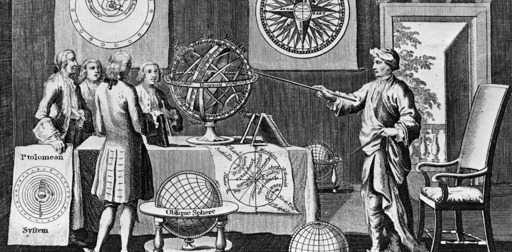
In the early 1700s, Isaac Newton’s followers turned abstract theory into public performance and cultural fashion.
At the time, Cartesian philosophy dominated intellectual life. Newton’s 1687 book “Principia Mathematica” proposed a new worldview of gravity, optics and motion, but the mathematics was so dense that few could grasp it.
Although Newton himself was a recluse, a circle of zealous Newtonian men of science, described by historians as devoted disciples and even evangelists for Newton’s natural philosophy, took his new theories on the road. These itinerant lecturers performed experiments and spectaculars in London coffeehouses and aristocratic salons, demonstrating Newtonian physics. They sold tickets, pamphlets and even branded scientific instruments so audiences could reproduce these marvels at home.