

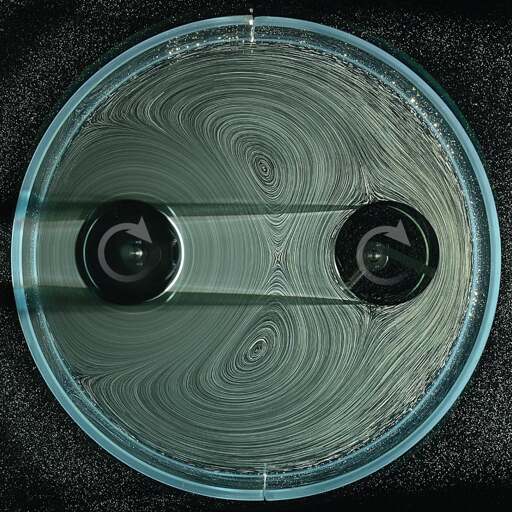
“Fluid gears” invention shows promise for improving mechanical devices.
This looked real cool at first, but a single glance at the video tells you all you need to know: this is useless and can’t be compared to gears in any way.
The torque is basically zero. You can’t use this to drive any load. They don’t couple like gears, they just have really really tiny effects on each other’s spin.
These quotes are hilarious:
“Regular gears have to be carefully designed so their teeth mesh just right, and any defect, incorrect spacing, or bit of grit causes them to jam,” explains Ristroph. “Fluid gears are free of all these problems, and the speed and even direction can be changed in ways not possible with mechanical gears.”
Fluid gears are free of all these problems, but they can’t drive anything! The speed can’t actually be controlled.
This is the homeopathy of gears.
It’s standard research paper language. It is motivating the purpose for investigating liquid gears and in no ways implies liquid gears are problem free.
The iterative steps of research involves addressing these challenges bit by bit until the last one is “solved”. It could be interesting to have many regular problems of standard gears a non-issue and only have to solve for the torque, the only thing remaining would be to see how much of a problem it is to solve. It could lead to niche applications too, not necessarily replace all existing gears everywhere.
I imagine there are probably some situations where close to zero (but not actually zero) torque is fine, where this may be useful. I don’t know what those are, but something that maintains a nearly constant speed it’d be OK. Once it’s up to speed you may not need much torque to keep it there. You can just slowly add or harvest energy from it. Maybe a flywheel or something? But yeah, this is certainly not replacing gears for most purposes. It’s next to useless in most applications for gears.
An automatic transmission is basically this, but well optimized.
Not transmission, torque converter.
Someone is trying to patent fluid coupling ?
My thought as well. This has already existed for many decades.
Invention? We are patenting the physics behind a whirlpool now? So fucking stupid
Wonder how applicable this is to real world use cases.
I would imagine fluids are more succesible to things like thermal expansion and external interference like vibration or changes in velocity etc.

