

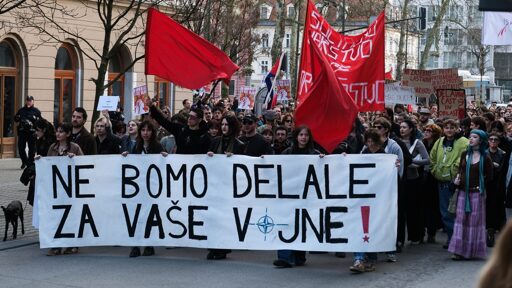
Hundreds of thousands joined demonstrations for International Working Women’s Day across Europe, protesting against ongoing militarization, austerity, and their impact on women’s lives in the region. From Spain to Romania, feminist groups and trade unions sounded the alarm against setbacks to women’s rights already being felt as a result of these trends, accompanied by the strengthening of the far right.
The demonstrations called for dismantling patriarchal structures, and expressed “sorrow and anger,” as Italian left party Potere al Popolo put it, against narratives propagated by European countries that advance the oppression of women across the world, notably in Palestine and other countries under attack by Israel and the United States. “Sorrow and anger because, in the name of women, they are justifying massacres against other women, like at the Minab elementary school, where a US-Israeli attack massacred at least 175 girls,” the party wrote.
Women against militarization
“Wherever military spending increases, sacrifices are imposed on those who keep the world going (from healthcare to education, from productive to reproductive work),” the collective Non Una di Meno wrote, commenting on militarization ongoing in Italy and misleading arguments to justify it. “Governments present war as a ‘necessary evil,’ the only way and essential action for the ‘peace’ they want to impose: a pacification needed to safeguard the interests of a system that’s trying to rebuild itself, offloading its crisis onto the shoulders of those who can be sacrificed in the name of hegemony over resources and the political and economic power that comes with it.”
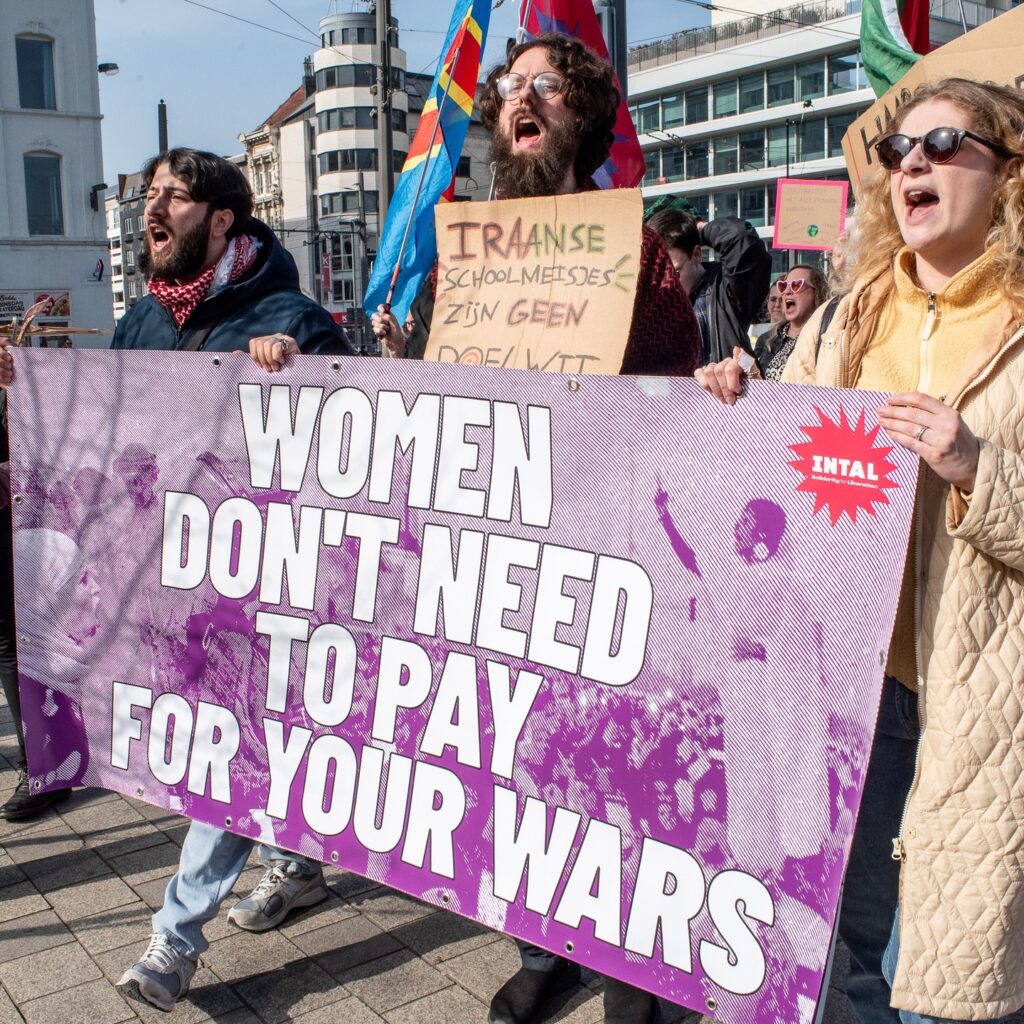
March 8 demonstration in Belgium. Source: Zelle Belgique/Facebook
In Slovenia, protesters marched to oppose plans to introduce military service spearheaded by right-wing and centrist forces ahead of the upcoming general election, among other things. According to the student association Iskra, these plans would cover both young men and women, with spillover effects on women students and workers. Iskra pointed out the arms race would affect women “initially by conscription into the army, but above all by eating into funds intended for public services – kindergartens, schools, homes for the elderly, etc.”
This would again worsen women’s position in society in multiple ways, by eroding their working conditions in these sectors and by shifting even more care burden onto them at home. “It’s clear that it’s us citizens who will pay the price for increased military spending, first with our own money and then with decent living conditions, because more funding for the military also means less funding for public services,” the group stated in its call to action.
Women against austerity
The same governments working diligently toward armament are responsible for the precarious conditions in which women still work compared to men. “Italy is still a deeply patriarchal society,” Potere al Popolo wrote. “Only 53.3% of women in Italy are in paid employment (compared to 71.1% of men), and often these jobs are precarious or part-time, with women earning on average 25% less than men.”
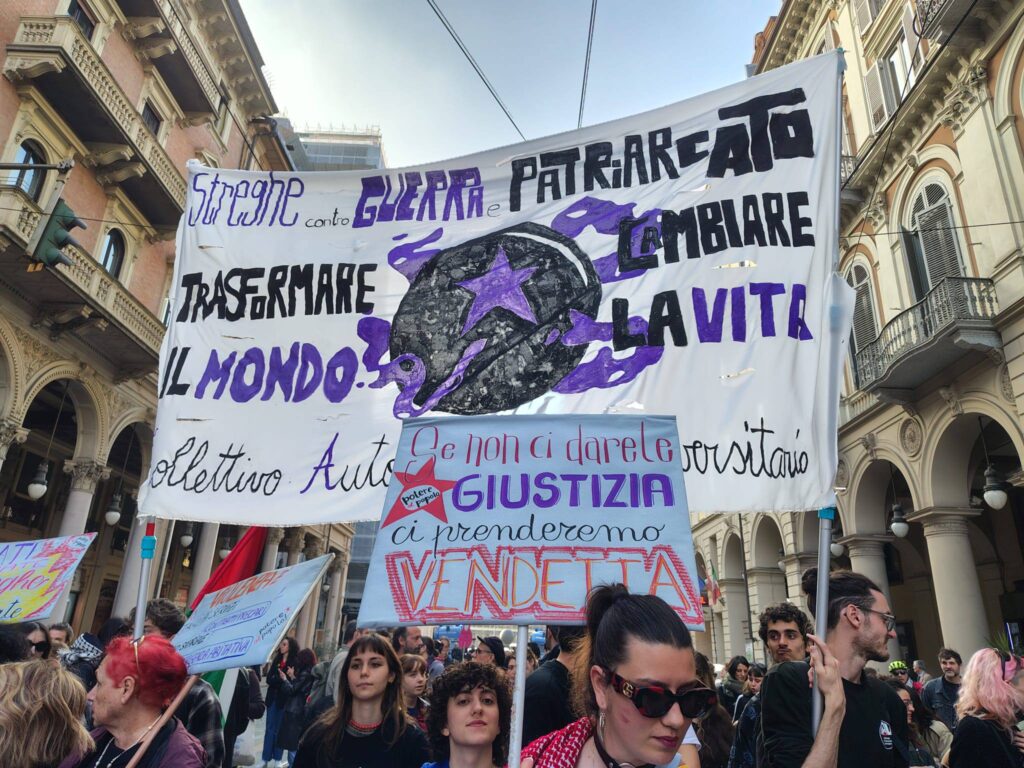
March 8 demonstration in Italy. Source: Potere al popolo Torino/Facebook
Women will also be affected by reforms envisioned by the right-wing government in Belgium, including attacks on the pension system and reduction of workplace protections particularly relevant for women workers. The government’s measures, according to Zelle, the women’s chapter of the Workers’ Party of Belgium (PTB-PVDA), “increase precarity and expose women to more violence,” making their participation in upcoming protests against the reforms crucial.
Women against fascism
The day’s events also emphasized the importance of building an organized response to the rise of the far right in the region. Right-wing parties and groups are capitalizing on the failure of centrist governments to provide alternatives to the cost of living crisis that has encompassed much of the region, caused by these same options’ neoliberal policies. The overlap between these forces has not only weakened public services in general, with healthcare representing a particular concern, but also meant that demands put forward by feminist movements for decades – notably access to safe abortion care – remain as timely as ever.

March 8 demonstration in France. Source: Mathilde Panot/Facebook
Many of the countries where protests took place, including France and Croatia, have experienced a resurgence of right-wing violence over the past months, adding another layer of threat to women’s organizing. As a result, March 8 demonstrations marched under banners reclaiming antifascist values and set out to incorporate these in upcoming struggles.
“March 8 is for everyone who dreams of a world without violence, poverty, and inequality,” feminist groups in Bulgaria wrote on the occasion of International Working Women’s Day. “Who wants their work to be respected and valued; who wants money for health, care, and education, not for wars and destruction.”
The post Women warn European governments on March 8: “We won’t work for your wars” appeared first on Peoples Dispatch.
From Peoples Dispatch via this RSS feed
Yes they will.